
The reason that I thought I should have a separate section to discuss money and women is because, apart from the fact that finance is positioned as a difficult subject to understand – Women have to face extra hurdles and barriers to
- Secure a source of income
- Ensure that the income is competitive
- Assert themselves in a male dominated world/ household/ workspace
- Overcome stereotypes about women being unable to handle or understand money
- Overcome fear and low self-esteem when it comes to money
- Fight people who bulldoze their opinions onto women
- Tolerate endless mansplaining and jargon that is wrapped around money
- Access to simple and easy-to-understand financial education
The rhetoric around money, especially for women is that it is difficult to understand and is steeped with the fear of the unknown. Pepper this with unrecognizable finance terms and we have a woman going deep into her shell unable to move with decision paralysis.
Here are some of the things that I have noticed about women and money –
- We are actually just as, if not more interested in building our wealth when compared to men
- We are resilient investors, not easily upset by the ups and downs of the market. So we make excellent long term investors. (only type of investing I know to be honest)
- We are insane savers. Oooh a woman and her shopping. Pish Posh. We can save like nobody’s business. Scrimping and saving is what we do baby!
Some myths about women and money –
- We are emotional investors. L.O.L. Sure. Women are no different from men. Some are emotional investors, some can be cold and calculating, some are easy-going, some are risk averse. Yes, we come in all shapes and sizes.
- Math is hard. I’m running out of LOLs to give. Again, we are just human beings, not born out of a unicorn on a blood moon day. Some get math, some don’t. But its not a barrier of entry for sure. My math is terrible, but I love finance. We exist.
- We are risk-averse. Yes we are. Some of us are gullible. Some of us are super smart. Some of us love research. Some of us can gamble all night.
All the myths around women and money come from painting a woman and her abilities with a single brush.
We’re not a homogenous group of people who think and operate the same exact way in any given situation.
Some depressing statistics that’ll most likely dampen your day –
Scroll down for India-related data
Excerpts from – https://www.weforum.org/reports/global-gender-gap-report-2022/digest
In 2022, the global gender gap has been closed by 68.1%. At the current rate of progress, it will take 132 years to reach full parity.

Among the eight regions covered in the report, South Asia ranks the lowest, with only 62.3% of the gender gap closed in 2022. This lack of progress since the last edition extends the wait to close the gender gap to 197 years, due to a broad stagnation in gender parity scores across most countries in the region.

In 2022, gender parity in the labour force stands at 62.9%, the lowest level registered since the index was first compiled. Among workers who remained in the labour force, unemployment rates increased and and has remained consistently higher for women.
While the share of women in leadership has been increasing over time, women have not been hired at equal rates across industries.
For frontline operational roles, the overall gender wealth gap amounts to 11%; for professional and technical type roles, the gender wealth gap nearly triples to 31%; and for senior expert and leadership roles it expands further to 38%.

INDIA RELATED STATISTICS
A slim majority of Indians (54%) say that both the men and the women in a family should be responsible for earning money. But 43% instead take the view that men should be the primary earners. Moreover, nearly two-thirds of Indians (64%) – including 61% of women – express complete agreement with the idea that a wife always is obligated to obey her husband. https://www.pewresearch.org/religion/2022/03/02/views-on-womens-place-in-society/
Younger Indian adults typically are no less traditional than their elders in their views on family gender roles, and these attitudes do not vary much between men and women. For instance, 33% of Indian women (along with 34% of men) say that sons should have greater rights than daughters to inherit from parents.
Most Indians say that both women and men should be responsible for earning money (54%), caring for children (62%) and making family financial decisions (73%). Still, substantial minorities have traditional views when it comes to family responsibilities, saying men should be the primary money earners in a family (43%) and women should be the primary caregivers for children (34%). And one-in-five adults say men should be the primary decision-makers about family expenses.
https://www.pewresearch.org/religion/2022/03/02/gender-roles-in-the-family/
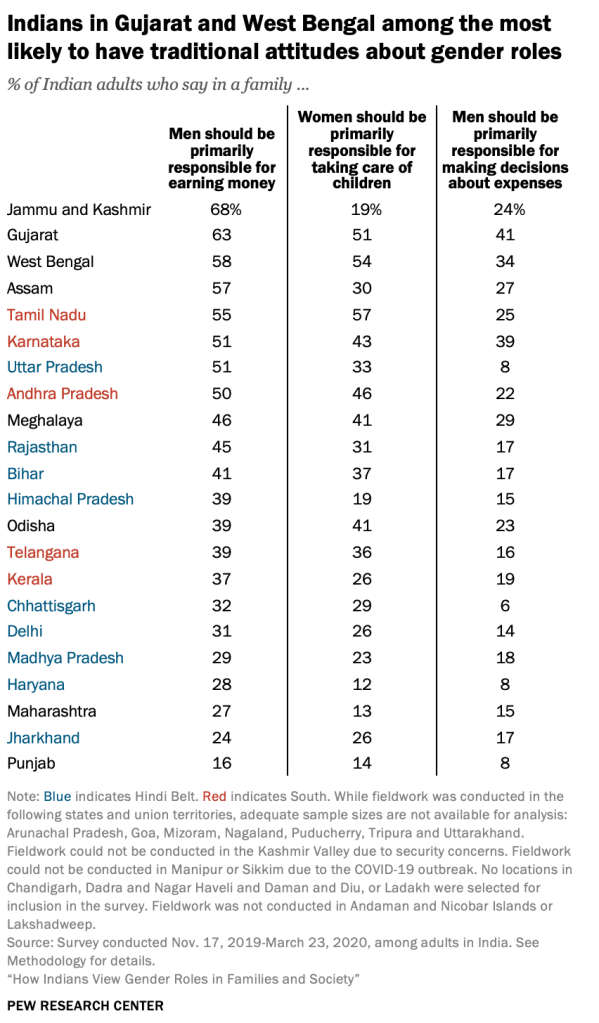
Even though most Indians think men and women should share in family responsibilities, nearly nine-in-ten Indians (87%) completely or mostly agree with the notion that “a wife must always obey her husband.” This includes a majority of Indians (64%) who completely agree with this sentiment. Women are only modestly less likely than men to say that wives should obey their husbands in all situations, and most women agree completely with this sentiment (61% vs. 67% among men).

Ending this on this slightly more positve note –
Nearly two-thirds of Indians (64%) say sons and daughters should have equal inheritance rights from parents, including majorities across all religious groups.
 The Money Wellness Studio
Leave a comment